Research Methods
The Molecular Zoology research group combines molecular, ecological, spatial, and data-driven methodologies within integrative analytical frameworks to investigate biological systems across multiple organizational, spatial, and temporal scales. Modern high-throughput technologies, spatially explicit analyses, environmental monitoring, and AI-supported data integration enable the linkage of genomics, behaviour, physiology, and ecology to study complex eco-evolutionary processes.
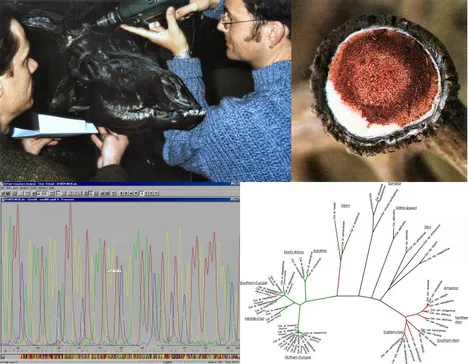
High-throughput sequencing technologies and functional genomic approaches are used to investigate genome structure, gene regulation, transcriptomic responses, and adaptive molecular mechanisms in natural populations. Integrative bioinformatic workflows enable the analysis and interpretation of complex multi-omics datasets across multiple biological scales.
Methods & Approaches
Whole Genome Sequencing · Transcriptomics · Differential Gene Expression Analyses · GWAS · Functional Annotation · AI-supported Bioinformatics
Comparative genomic and phylogenetic approaches are applied to reconstruct evolutionary relationships, demographic histories, speciation processes, and spatial patterns of diversification. Modern statistical and computational methods enable the investigation of evolutionary dynamics across temporal and geographic scales.
Methods & Approaches
Phylogenomics · Bayesian Inference · Coalescent Modelling · Demographic Analyses · Evolutionary Reconstruction · Species Delimitation · Population History Analyses
Spatially explicit genetic and ecological analyses are used to investigate how environmental gradients, habitat structure, and landscape connectivity influence gene flow, local adaptation, and biodiversity dynamics. Molecular data are integrated with GIS-based environmental analyses and spatial modelling approaches.
Methods & Approaches
Landscape Genetics · Landscape Genomics · GIS-based Spatial Analyses · Connectivity Modelling · Habitat Suitability Modelling · Resistance Surface Analyses · Remote Sensing Integration
High-resolution telemetry and environmental monitoring approaches are used to investigate animal movement, habitat use, behavioural dynamics, and ecological interactions across spatial and temporal scales. The integration of biologging technologies and environmental datasets enables mechanistic insights into organism–environment interactions under natural conditions.
Methods & Approaches
GPS Telemetry · Biologging · Accelerometry · Behavioural State Modelling · Drone & Satellite-based Habitat Analyses · Environmental Monitoring · Spatial Movement Analyses
Modern quantitative and computational approaches are applied to analyse complex ecological and evolutionary datasets and to develop mechanistic and predictive models of biological systems. AI-supported analyses, machine learning, and spatial statistics enable the investigation of nonlinear ecological dynamics across multiple scales.
Methods & Approaches
Machine & Deep Learning · AI-supported Data Analysis · Bayesian Statistics · Spatial Statistics · Hierarchical Modelling · Ecological Forecasting · Network Analyses · Big-Data Integration - High Performance Computing (HPC)
Non-invasive molecular approaches are used to monitor biodiversity, population dynamics, and conservation-relevant processes in natural systems. Environmental DNA and genetic monitoring techniques provide efficient tools for assessing species occurrence, genetic diversity, and ecological change under natural and anthropogenic conditions.
Methods & Approaches
eDNA Analyses · Metabarcoding · Non-invasive Genetics · Population Monitoring · Biodiversity Assessment · Conservation Genetics · Molecular Species Detection