Research interest Prof. Dr. Claus Schwechheimer
Regulation of Plant Growth through Hormone Signaling Pathways, Protein Phosphorylation, and Targeted Protein Degradation
During plant growth, growth, differentiation, and organ formation must be precisely coordinated in time and space to ensure robust developmental programs and flexible adaptive responses to environmental conditions. These processes rely heavily on the controlled perception, transmission, and integration of signals. Plant hormones such as auxin and gibberellins play a central role in this context, as their local distribution and cellular signal transduction govern growth processes. Equally important are post-translational regulatory mechanisms, in particular protein phosphorylation and targeted protein degradation via the ubiquitin–proteasome system. These mechanisms enable plants to implement developmental decisions rapidly, specifically, and reversibly.
A central focus of my research is to understand how plant hormone signaling pathways are regulated at the molecular level and how they control cell and tissue growth. In particular, I investigate how the activity and subcellular localization of protein kinases regulate polar auxin transport, how the gibberellin signaling pathway controls gene expression and growth responses through DELLA proteins, and how both processes are linked to post-translational modifications and selective protein degradation. Of particular interest is how phosphorylation, plasma membrane polarization, and protein stability act together to enable directional growth, tropic responses, and organ development.
In addition, my research group investigates how signaling networks can be captured and functionally analyzed using systems biology approaches. To this end, we combine genomic, proteomic, and phosphoproteomic datasets with genetic, biochemical, and cell biological experiments to identify regulatory modules and test them mechanistically. Our goal is to understand the general principles by which plants integrate hormonal signals, environmental cues, and intracellular regulatory mechanisms to precisely control growth and development. Arabidopsis thaliana serves as our central model system.
Previous Results
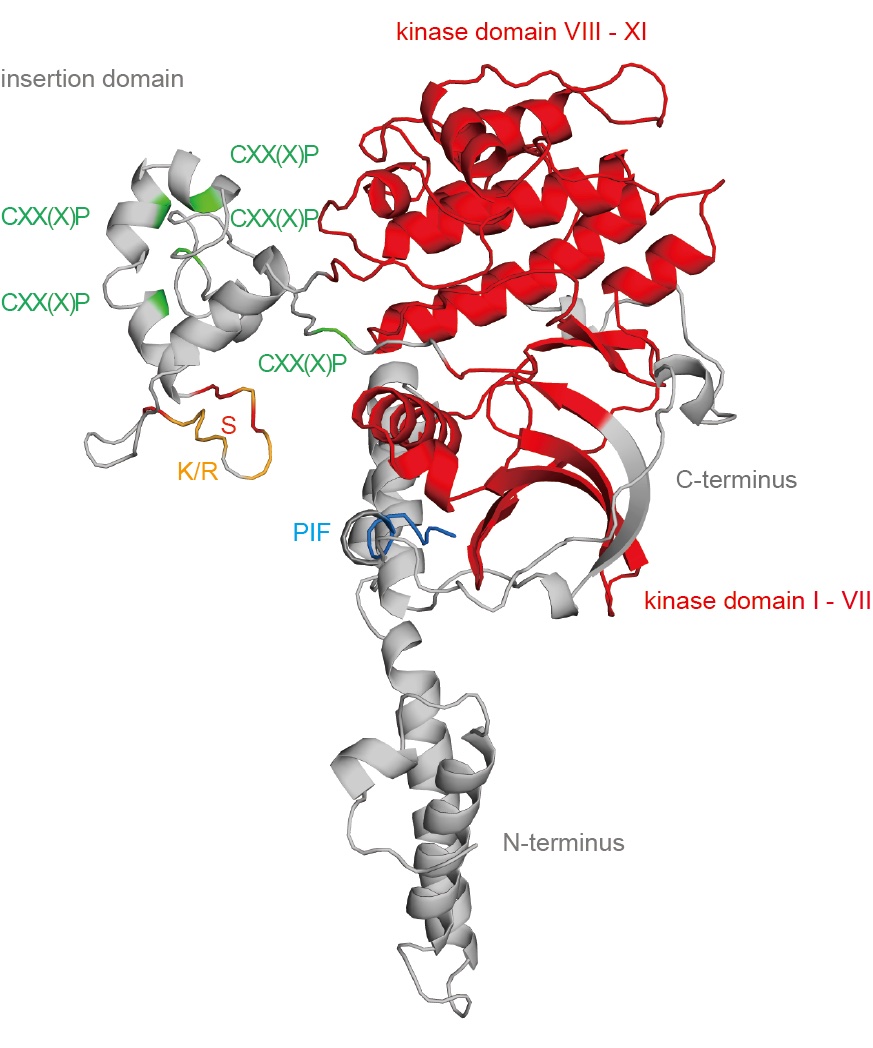
• We have shown that the polarly localized AGC kinase D6 PROTEIN KINASE (D6PK) is a central regulator of efficient auxin transport. D6PK activates PIN-dependent auxin transport processes and is therefore essential for directional growth, organ formation, and tropic responses (Zourelidou et al., 2009; Graf et al., 2024).
• We have shown that plasma membrane polarization of D6PK is controlled by specific protein motifs and PDK1-dependent phosphorylation. These findings provide important mechanistic insights into how the subcellular distribution of signaling components determines the spatial precision of auxin transport (Graf et al., 2024).
• We have shown that the gibberellin signaling pathway, through DELLA proteins, regulates key growth and stress responses. In this context, DELLA proteins interact with growth regulators and couple hormonal signals to transcriptional control, for example under cold stress (Lantzouni et al., 2020).
• We have shown that gibberellin transport itself is actively regulated: the Arabidopsis protein NPF3 functions as a gibberellin transporter and thereby represents an important additional layer in the control of hormonal signal distribution (Tal et al., 2016). In addition, it has been shown that mobile gibberellins directly promote secondary growth and xylem expansion (Ragni et al., 2011).
• Our extensive work on B-GATA transcription factors, which were identified on the basis of their regulation by the gibberellin pathway, shows that these proteins play important roles in regulating chlorophyll biosynthesis, chloroplast development, and nutrient responses, thereby linking hormonal and metabolic signals to developmental programs (Bastakis et al., 2018; Zappone et al., 2026).
• Our work has also made important contributions to understanding how targeted protein degradation, mediated by Cullin-RING E3 ubiquitin ligases, the COP9 signalosome, and the NEDD8 cycle, regulates plant developmental processes. These systems represent central regulatory nodes for the controlled activation or degradation of signaling components (Schwechheimer & Calderón Villalobos, 2004; Schwechheimer & Isono, 2010; Mergner et al., 2017).
Research Goals
• We aim to understand how the spatial organization of signaling proteins at the plasma membrane determines the direction and efficiency of auxin transport and thereby controls developmental processes at the organ and tissue levels.
• We plan to identify the molecular mechanisms of phosphorylation-dependent regulation of kinases, transport proteins, and signaling modules that are required for polar growth, tropic responses, and morphogenesis.
• In addition, we seek to determine how gibberellin signaling, DELLA-mediated transcriptional control, and hormone transport interact to coordinate growth and environmental responses.
• Another goal is to elucidate the role of targeted protein degradation and ubiquitin-/NEDD8-dependent regulatory processes in the fine-tuning of hormonal signaling pathways.
• In the long term, this work aims to provide integrated models describing how plants combine hormonal signals, post-translational modifications, and systemic regulatory networks to establish developmental programs that are both robust and adaptable.
Methods
Confocal live-cell imaging using fluorescent reporters to analyze protein localization, plasma membrane polarization, and growth
Genetic analyses in Arabidopsis thaliana, including mutant and transgenic lines
Biochemical and cell biological characterization of kinases, transporters, and signaling proteins
Proteomics and phosphoproteomics to identify regulatory networks and post-translational modifications
Systems biology-based analysis of genomic and proteomic datasets to generate and test functional hypotheses
