
Process-structure relationships of wheat protein vital gluten
| Abbreviation: | Process/Structure of vital gluten |
| Project Group: | Nina Höller |
| Funding: | BMWK, AiF 21289 N |
| Duration: | 2020 - 2023 |
| Grant recipient: | Karlsruhe Institute of Technology (KIT) |
| Partner: | Technische Universität München, TUM School of Life Sciences, Lehrstuhl für Brau- und Getränketechnologie, Arbeitsgruppe Getreidetechnologie und -verfahrenstechnik |
| Further Links: | Projektkurzbericht |
Vital gluten is gently dried and powdered wheat protein (gluten) that is produced as a by-product during the industrial extraction of wheat starch. In the food industry, vital gluten is mainly used as an ingredient in baked goods to strengthen the protein network, control processing properties, and improve the quality of the end product. Due to its unique viscoelastic properties, vital gluten is also increasingly being used in the non-food sector, i.e., in animal feed, cosmetics, and adhesive or film-forming materials. In addition to the use of different wheat varieties and qualities for starch production, it is known that the manufacturing process has a decisive influence on the structure and functionality of vital gluten.
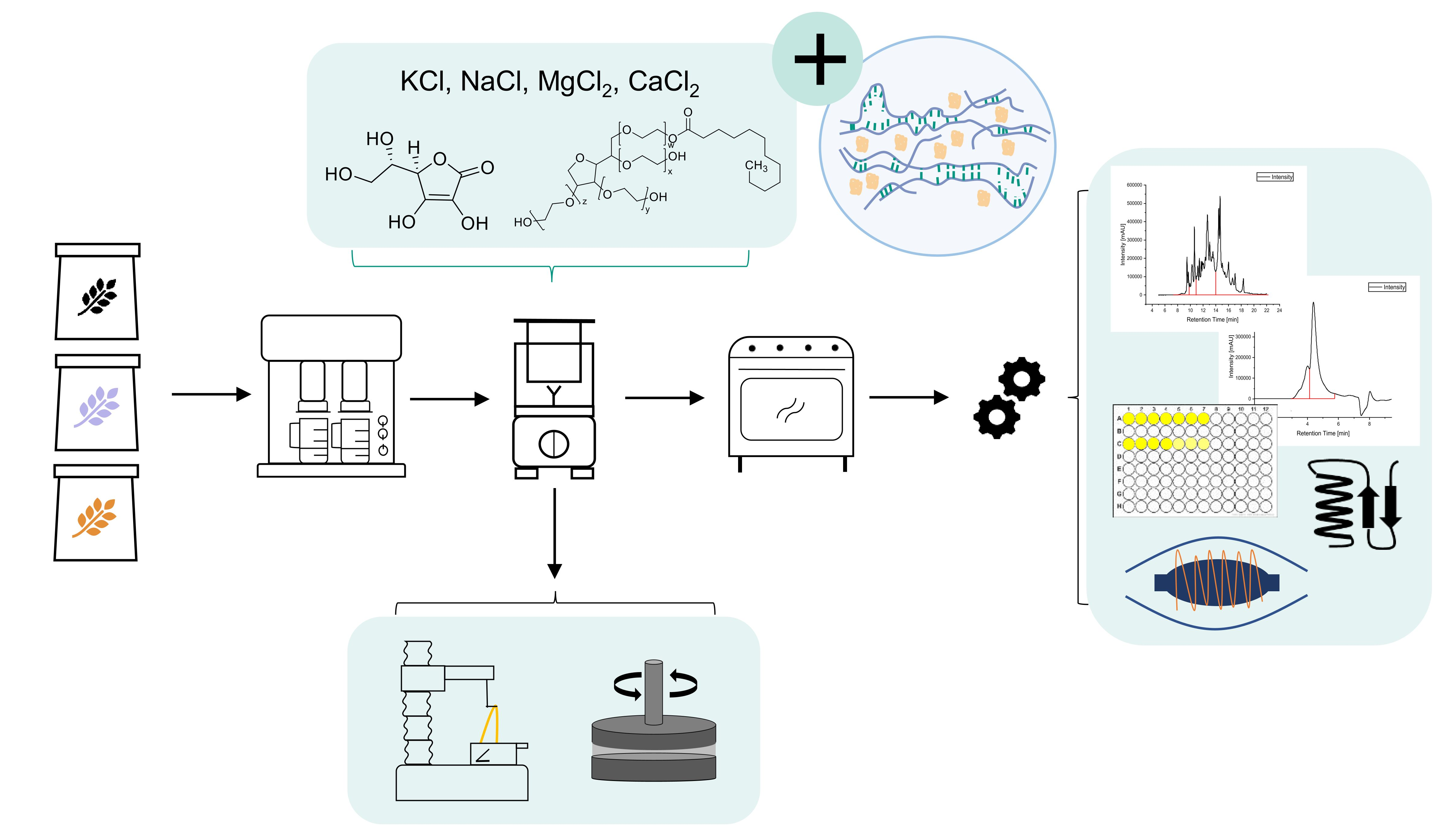
The aim of the research project was to systematically investigate the influence of environmental and process conditions during extraction and post-treatment (drying and grinding) on the structure and functionality of polymerized wheat protein and vital gluten.
The systematic investigation of the influence of environmental conditions on the efficiency of the extraction process and vital gluten functionality showed that the efficiency of the extraction process could be increased by chloride salts in the washing water and a softer dough consistency. High process temperatures reduced the yield of the extraction process regardless of the flour quality or type. A principal component analysis confirmed the potential to control vital gluten functionality by means of environmental conditions. The combination of environmental and process conditions showed that the adverse effect of thermal stress on vital gluten functionality can be partially counteracted by the use of chloride salts as an environmental or process condition.
During post-treatment, salts primarily caused changes in the gliadin content, the ratio of gliadins to glutenins, the content of disulfide bonds, and the ratio of disulfide bonds to free thiols. The additives 0.5% CaCl₂, 3% MgCl₂, and 1% Tween 20 had significant effects on several of the measured parameters for all three flours. The divalent salts CaCl2 and MgCl2 resulted in a more elastic, less strong gluten network in the flour mixture, while NaCl contributed to a cross-linked gluten network with large protein aggregates. Synergistic effects from environmental and process conditions showed that thermal treatment during the washing and drying of the vital gluten reduced the content of free thiols, thereby increasing the proportion of large protein aggregates (glutenins and glutenin macropolymers). Samples that were additionally treated with chloride salt generally followed the same trend, but the effects of thermal treatment were significantly reduced in some cases. The addition of CaCl2 in particular had a pronounced effect on the protein structure.
