
Spectroscopic analyses of flour fractions and extracts to predict the baking behavior of wheat from different origins and elucidate molecular mechanisms
| Abbreviation: | Analysis of flour fractions |
| Project Group: | Lukas Buck |
| Funding: | BMWK, AiF 21711 N |
| Duration: | 2021 - 2024 |
| Grant recipient: | Karlsruhe Institute of Technology (KIT) |
| Partner: | Universität Hohenheim, Institut für Lebensmittelwissenschaft und Biotechnologie, Fachgebiet für Prozessanalytik |
| Further Links: | Project report |
Wheat breeders, wheat traders, millers, and bakers have long wanted to be able to predict the expected processing properties of flours as accurately as possible based on rapid analyses of the raw material wheat. Although genetics allow conclusions to be drawn about the predisposition of individual wheat varieties, genetic traits vary in intensity depending on growing conditions, meaning that the composition of flours can vary considerably from location to location even when using the same wheat variety, with proteins having a very large influence on the processing properties of flours. In view of the forced reduction in nitrogen fertilization, the identification of wheat varieties that offer good processing properties despite low protein content is becoming increasingly important.
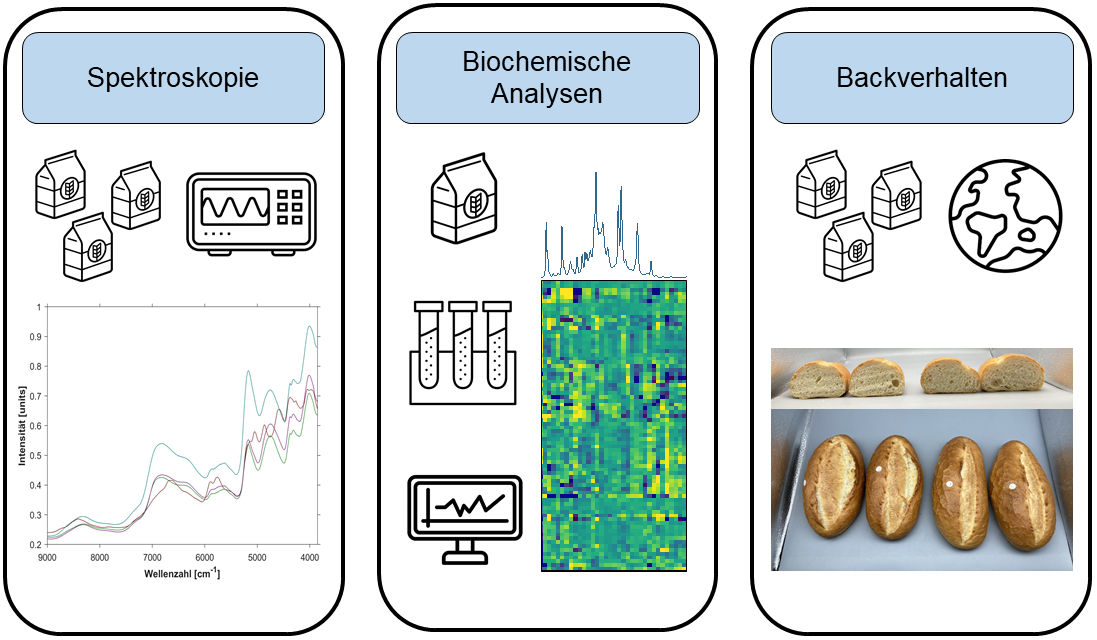
The aim of the research project was to expand knowledge for assessing the baking properties of flour and, based on a spectroscopic analysis of flour fractions and extracts, to create robust chemometric models that can be used to predict the baking quality of commercial flour from its spectra.
A sample assortment of 77 wheat flour mixtures (samples) from the 2021-2023 growing seasons from different countries around the world was analyzed. To this end, several baking tests were first carried out and, among other things, the specific bread volumes were determined. In addition, the samples were examined using spectroscopic and biochemical methods. The flours were also fractionated mechanically using air separation, sieve fractionation, and dough/gluten/starch fractionation. The gluten and glutenin content in particular showed a correlation with the bread volumes.
The prediction of baking quality, characterized by the specific baking volume, could be significantly improved using various methods. Three main methods were used: (a) prediction based on fluorescence, NIR, and Raman spectra of flour and flour fractions (b) prediction based on a variety of rheological and analytical data (e.g., farinograph, extensograph, alveograph, protein content, Osborne fractions, SDS-GMP fractionation, solvent retention capacity (SRC), etc.) (c) prediction based on a combination of flour spectra and rheological and analytical data. Very good predictions were achieved with a wide variety of models of methods (a)-(c).
